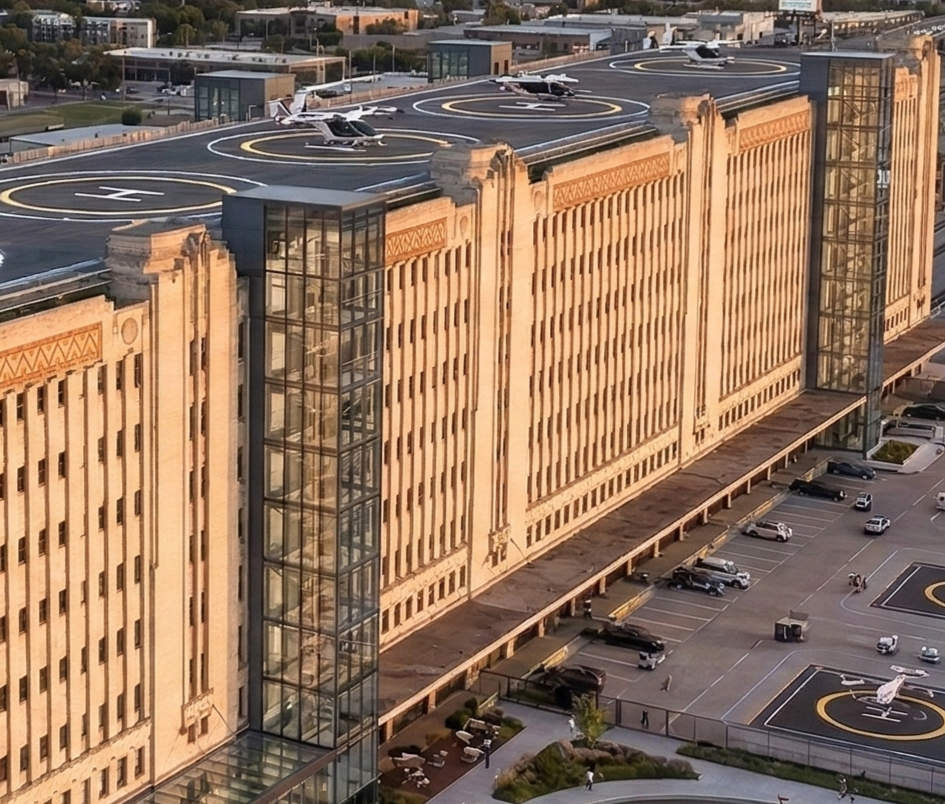
Trinity Air Link mobility hub exterior with integrated urban access
Texas & Pacific Warehouse • Fort Worth, TX • DFW Metroplex
Breaking: Texas Selected for Federal eIPP — Deployment Planning Active (Certification-Dependent)

Fort Worth's Future of Air Mobility

Transform the historic Texas & Pacific Warehouse into a capital-light, integrated air-and-ground mobility hub for the DFW region. Trinity Air Link combines infrastructure, operations enablement, and adaptive reuse of a landmark site to improve regional connectivity while preserving long-term strategic flexibility.
Texas selected for the federal eIPP program — network deployment planning is active, with operations subject to FAA certification milestones.

8.5M

DFW Population

Fastest-Growing US Metroplex

24.8%

Calculated IRR (Before Terminal)

10-year, capital-light moderate case

$89.7M

NPV @ 10%

Before terminal value

$107M–$113M

Capital-Light Case

Preferred operator-access model
First-Touch System Overview

The TAL System: Integrated Mobility Network

The TAL system is designed around one strategic node: the Texas & Pacific Warehouse in Fort Worth. It combines air mobility, ground mobility, and innovation-center tenancy in a capital-light operating model that prioritizes phased execution, partner access, and regional connectivity.

Rooftop vertiport pad supporting VTOL arrivals and departures
VTOL Operations

Air Mobility

Rooftop vertiport infrastructure is planned to support certified operator service between key DFW nodes as market readiness and certification milestones are met.

Autonomous electric shuttle docking lanes inside the Trinity Air Link hub
Autonomous EV Networks

Ground Mobility

Ground mobility operations are structured to connect riders from regional transit and neighborhood origin points into a unified first/last-mile network.

Innovation Center workspace with collaborative research areas
Technology Innovation

Innovation Center

The innovation center adds durable non-ticket revenue through leasable space for mobility, logistics, and advanced-technology tenants aligned with the transportation mission.

Due Diligence

The Challenge: Calculated Risks

Transparent assessment of current challenges creates the foundation for strategic transformation and stakeholder confidence.

Decades of Inaction

The Texas & Pacific Warehouse has remained vacant since its acquisition in 1998. The property has a documented history of "years of announcements, false starts, multiple extended deadlines," and terminated city incentives. The current owner attributes delays to outside influences, but the city terminated an $11M+ TIF agreement in 2016 due to an "inability to provide a funding plan."

Market Advantage

The Opportunity: Perfect Timing

External market forces and unprecedented public investment create an ideal environment for transformative development.

$1B+ Development Pipeline

Strategic location at the epicenter of massive regional growth including Texas A&M expansion ($320M), convention center modernization, and Omni hotel tower ($217M).

$182M Public Infrastructure

Complete reconstruction of East Lancaster Avenue with smart city infrastructure, transit improvements, and pedestrian enhancements - de-risking private investment.

Comprehensive Incentive Package

Tax abatements, façade grants, catalytic development funding, and targeted surface parking redevelopment incentives through PID 20 partnership.

DFW Market Context: Perfect Storm for Innovation

The Dallas-Fort Worth metroplex presents unprecedented market conditions for transportation innovation - combining massive scale, economic strength, and critical infrastructure needs.

8.5M

Population

4th Largest US Metroplex

$710B+

Regional Economy

3rd Largest US Metro Economy

3.5%

Annual Growth

Fastest-Growing Major Metro

45min

Average Commute

Significant Time Lost to Traffic

Transportation Challenges

  • Severe Congestion: Fort Worth ranked 10th worst U.S. commute city — 69 hours lost per commuter annually ($1,618/driver)
  • Growing Delay Crisis: 174 million collective DFW delay hours in 2024 — up 8% year-over-year
  • Last-Mile Problem: Limited connectivity between transit nodes and final destinations
  • $36.4B Cost by 2050: Projected annual congestion cost to DFW economy without intervention
  • Environmental Impact: High emissions from car-dependent sprawl — DFW car ownership rate over 95%

Strategic Advantages

  • Federal eIPP Selection (March 2026): Texas + Archer Aviation selected for U.S. DOT's eVTOL Integration Pilot Program — with integration planning active for Texas operations while FAA certification requirements remain in force
  • Waymo in Texas: Autonomous robotaxi service operating commercially in Austin — 450K+ rides/week; direct precedent for DFW AV deployment
  • $710B+ Economy: 3rd largest U.S. metro economy — Fort Worth crossed 1 million residents; corporate relocations accelerating
  • PPP Framework: Existing public-private partnership infrastructure and Texas innovation-friendly regulatory environment
  • First-Mover Advantage: Fort Worth not yet on air taxi map — Trinity Air Link positions city as the Texas eVTOL hub before competitors

TAL System Market Applications

🏢

Business Travel

Rapid transport for professionals between commercial districts and business centers

✈️

Airport Connections

Seamless links between DFW/Love Field airports and urban centers

🏘️

Urban-Suburban Links

Efficient connectivity between suburban areas and urban centers

🚨

Emergency Services

Rapid medical and emergency transportation capabilities

🎯

Event Transportation

Efficient movement to major sporting and cultural events

🧪

Innovation Ecosystem

Technology development and testing environment attracting companies

How the TAL System Works

At first touch, the model is straightforward: one strategic hub, multiple operators, and phased launch discipline.

Global Precedents: Lessons from Leading Cities

Insights from successful urban transportation initiatives worldwide demonstrate the feasibility and best practices for the Trinity Air Link system in DFW.

Street-level autonomous vehicle pickup zone
Singapore's AV Initiative

SG Singapore

Creating dedicated test zones with strong government support and phased regulatory development is crucial for autonomous vehicle integration. Singapore's approach offers a valuable blueprint for the TAL system.

Rooftop VTOL landing infrastructure
Dubai's Urban Air Mobility

AE Dubai

Urban air mobility integration is feasible in major metropolitan areas by focusing on vertiport infrastructure and dedicated airspace management systems, offering insights for the VTOL component of the TAL system.

Multimodal smart transport grid and control framework
Seoul's Smart Transport Grid

KR Seoul

Comprehensive data integration and AI-powered traffic management, including digital twins, can significantly reduce congestion and optimize transportation networks, informing the TAL system's management capabilities.

Interior shuttle docking — multi-modal hub interior
London's Multi-Modal System

UK London

Successful multi-modal integration and unified payment systems, alongside converting historic transport buildings into modern mobility hubs (like King's Cross), provide a direct template for the Texas & Pacific Warehouse transformation.

Electric vehicles docked and charging at mobility hub
Zurich's Electric Mobility

CH Zurich

Best practices for electric vehicle infrastructure and smart grid integration can be achieved through public-private partnerships, offering a blueprint for the TAL system's EV charging component.

Historic warehouse building exterior — future mobility hub
LA Union Station Hub

US Los Angeles

Transforming historic railway stations into multi-modal mobility hubs with integrated autonomous vehicle testing zones and mixed-use development provides a direct parallel and strong validation for the Texas & Pacific Warehouse concept.

Implementation Strategy: 4-Phase Roadmap

Strategic phased implementation minimizes risk, validates technology, and ensures stakeholder confidence while building toward full-scale operations across the DFW metroplex.

1

Foundation

0-12 Months

$20M Investment

2

Infrastructure

13-24 Months

$50M Investment

3

Pilot Operations

25-36 Months

$10M–$32M Investment

4

Full Operations

37+ Months

$22M Investment

Texas and Pacific Warehouse exterior — Phase 1 rehabilitation target
Phase 1: Building Rehabilitation
Interior shuttle docking infrastructure — Phase 2 build-out
Phase 2: Infrastructure Build-Out
Rooftop vertiport with green landscaping — Phase 3 pilot operations
Phase 3: Pilot Operations

Risk Mitigation Strategy

  • Phased Implementation: Validates technology and market demand before major investment
  • Technology Partnerships: Established companies with proven VTOL and autonomous vehicle track records
  • Regulatory Engagement: Early collaboration with FAA, TxDOT, and local authorities
  • Diversified Funding: Multiple revenue streams and investment sources reducing single-point failure

📊 Success Metrics

Phase 1 Targets

  • • Property secured and initial repairs completed
  • • $15-25M funding raised
  • • Core team assembled and partnerships established

Phase 2 Targets

  • • Building rehabilitation completed
  • • VTOL and AV infrastructure operational
  • • Technology systems integrated and tested

Phase 3 Targets

  • • 1,000+ pilot program participants
  • • 95%+ safety rating achieved
  • • Break-even operational model validated

Phase 4 Targets

  • • 10,000+ daily passengers across network
  • • 5+ secondary hubs operational
  • • Technology licensing revenue active

Stakeholder Benefits: Value for Everyone

The Trinity Air Link system creates compelling value propositions across all stakeholder groups, aligning interests through shared benefits in economic growth, innovation leadership, and community development.

Building History

A Storied History

From an icon of industry to a symbol of neglect, the warehouse's timeline reveals a complex past. Click any event to learn more.

The Financial Picture

Investor model update: 24.8% calculated IRR (10-year, before terminal value), $89.7M NPV @ 10% before terminal value, and 36.8% IRR with $293.2M NPV including illustrative terminal value. Terminal value is presented separately as exit/refinance upside and is not counted as operating cash flow.

Available Redevelopment Incentives

The city and PID 20 offer numerous programs to support a viable project. Click each card for details.

The Window Is Open — Act Now

How to Get Involved

Texas is on the federal eIPP map. Archer Aviation and public-sector partners are planning Texas network deployment, with operations subject to FAA certification requirements. Trinity Air Link is positioned to be Fort Worth's anchor in this network — and we're actively building the coalition to make it happen.

Invest in the Infrastructure Layer

Join the Phase 1 financing for regulatory pathway, site control, partner agreements, design, and public-sector alignment. The base case model produces a calculated 24.8% IRR (10-year, before terminal value), with terminal value presented separately as exit/refinance upside.

Technology Partnership

Capital-light operator access model: certified eVTOL and qualified AV operators carry vehicle capex while Trinity Air Link monetizes vertiport access, AV bays, charging, dispatch, passenger processing, data, and service standards. Technology partners can deploy into a real-world DFW network environment.

Government & Regulatory

City officials, TxDOT, FAA, and federal program offices — we're seeking municipal endorsements, public-private partnership structures, and early regulatory coordination to fast-track vertiport designation.

Research & Academic

Universities, research institutions, and innovation labs — floors 3-7 of the Texas & Pacific Warehouse are designed as dedicated R&D space. We're seeking founding research partners for transportation, AI, and sustainability programs.

Community & Media

Fort Worth residents, civic organizations, neighborhood associations, and media — Trinity Air Link is built for this community. We welcome public engagement, press inquiries, and community input on how this project serves Fort Worth.

Schedule a Briefing

Ready to learn more? We offer tailored briefings for investors, government officials, and technology partners. Receive a full project overview, financial model walkthrough, and Q&A with the founding team.

Investor Document Library

Investor-facing material aligned to the capital-light operator access model and the calculated 10-year return framework.

Need Additional Diligence Materials?

Additional diligence files are available by request for qualified investor, government, and technology partners.

Email Document Request
Ready to Build the Future?

Partner with Us

Join us in creating Fort Worth's first fully integrated air mobility hub. Whether you're an investor, technology partner, or stakeholder, we're ready to build the future together.

Investment Partners

Unique opportunity to lead the mobility revolution

Technology Partners

Collaborate on cutting-edge VTOL and AV integration

Government Partners

Shape policy for next-generation transportation

Stakeholder Intake Routes

Use the route that matches your organization type. All inboxes are monitored by the TAL Program Management Office.

Investor Route

Owner: Capital Formation Lead — investors@trinityairlink.com

Government Route

Owner: Government Affairs Lead — government@trinityairlink.com

Technology Route

Owner: Integration Partnerships Lead — technology@trinityairlink.com

Community Route

Owner: Community Relations Lead — community@trinityairlink.com

SLA: stakeholder inboxes are monitored Monday-Friday with an initial response target of 2 business days.

Next Milestone Meeting

Phase 1 Stakeholder Engagement Review

Date: Q2 2026 — Active stakeholder engagement underway

Status: Phase 1 — Active Development & Stakeholder Engagement

Interactive Demo — Book a Flight

Trinity Air Link Booking App

Explore the full booking experience — routes, schedules, and seat selection — in our interactive demo.

Open Full Screen