Confidential Investment Brief | March 2026
Trinity Air Link
Transportation System
America's First Integrated eVTOL & Autonomous Vehicle Transportation Hub
Fort Worth, Texas
A compelling investment opportunity at the intersection of advanced air mobility, autonomous vehicles, and transit-oriented real estate in one of America's fastest-growing metro regions.
$107M–$113MCapital-Light Case
24.8%Calculated IRR
Before Terminal
8.0xExit Multiple
(Moderate)
2030Breakeven Year
Investment Opportunity
$107M–$113M
Capital-Light Case
24.8%
Calculated IRR Before Terminal
$133M
Year 5 Revenue (Moderate)
8.5M
DFW Metro Population
First-Mover
No Comparable Hub in TX
Investment Thesis
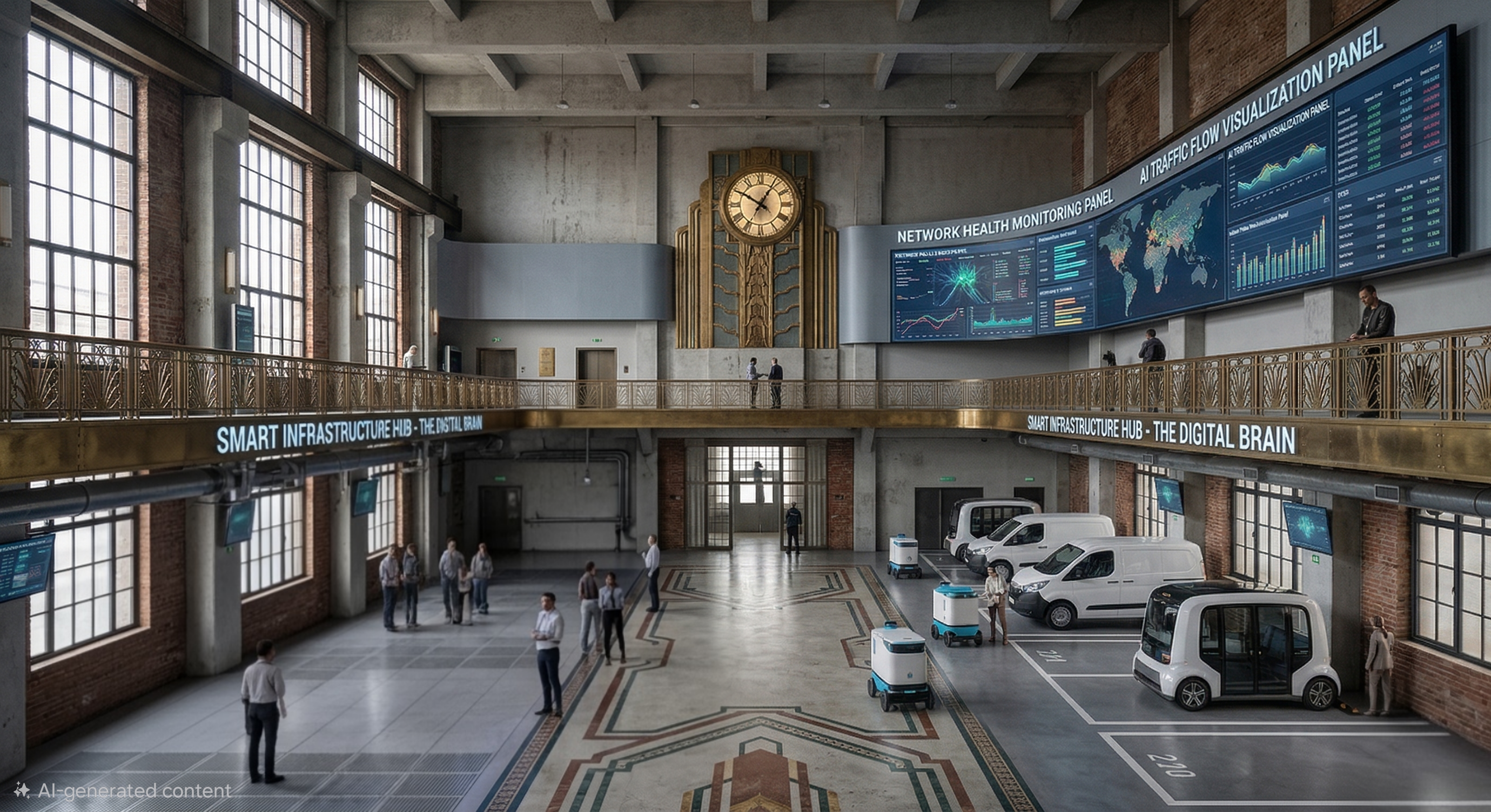
- Infrastructure platform play. Trinity Air Link does not need to own every vehicle in the network. It wins by owning the node every certified operator needs to use: the hub, terminal infrastructure, rooftop vertiport access, ground AV bays, charging/energy systems, passenger processing, dispatch/scheduling software, data/traffic management, service standards, and operator agreements.
- Federal regulatory tailwind. The FAA's eVTOL Integration Pilot Program (eIPP), announced March 9, 2026, selects Texas DOT + Archer Aviation as a national site — accelerating operational integration and public-sector coordination while FAA certification requirements remain in force.
- Historic asset with tax advantages. The T&P Warehouse qualifies for 20% Federal Historic Tax Credits, reducing effective renovation cost by $3–4M.
- Multiple revenue streams. Air and ground mobility platform fees (pad access, stand/use, passenger facility charges, terminal fees, charging/energy markup, dispatch software, data services, maintenance bay/hangar access, revenue share) + 120,000 SF Innovation Center real estate + technology licensing + ancillary retail/cargo.
- Zero municipal capital required. City provides regulatory facilitation and potential bond support; private capital deploys into a commercially structured entity.
Preferred Capital-Light Model: Trinity Air Link is structured as the infrastructure, terminal, charging, dispatch, and passenger-processing layer. Certified third-party operators may provide the aircraft and autonomous vehicles, allowing the project to reduce Phase 3 capital exposure while preserving high-margin platform revenue.
The Market Inflection
DFW Transportation Crisis
- 69 hours lost per DFW commuter annually (TX A&M, 2024)
- $1,618 annual cost per commuter — fuel + productivity
- 44 of Texas' 100 most congested roads are in DFW
- 10th worst commute in the U.S. — Fort Worth (Forbes, 2025)
- <1% of workers use public transit
- Congestion cost projected to reach $36.4B/year by 2050
eVTOL & AV Readiness
- Archer Aviation: Part 135/145 certified; commercial revenue Q1 2026; Texas eIPP selected
- Joby Aviation: FAA Stage 4 of 5 certification; Toyota-backed $1B+; commercial 2026
- Waymo Level 4: Austin, TX commercial ops March 2025; 450K+ rides/week
- UAM market: $4.6B (2024) → $29.2B (2030); 31–34% CAGR
- FAA eIPP supports route/system integration planning; passenger service remains subject to FAA certification milestones
The Timing: The window to establish the Fort Worth vertiport anchor for the Texas eIPP network is now. Dallas is named in the initial Texas eIPP route set; Fort Worth is the adjacent market requiring an infrastructure node.
The Asset
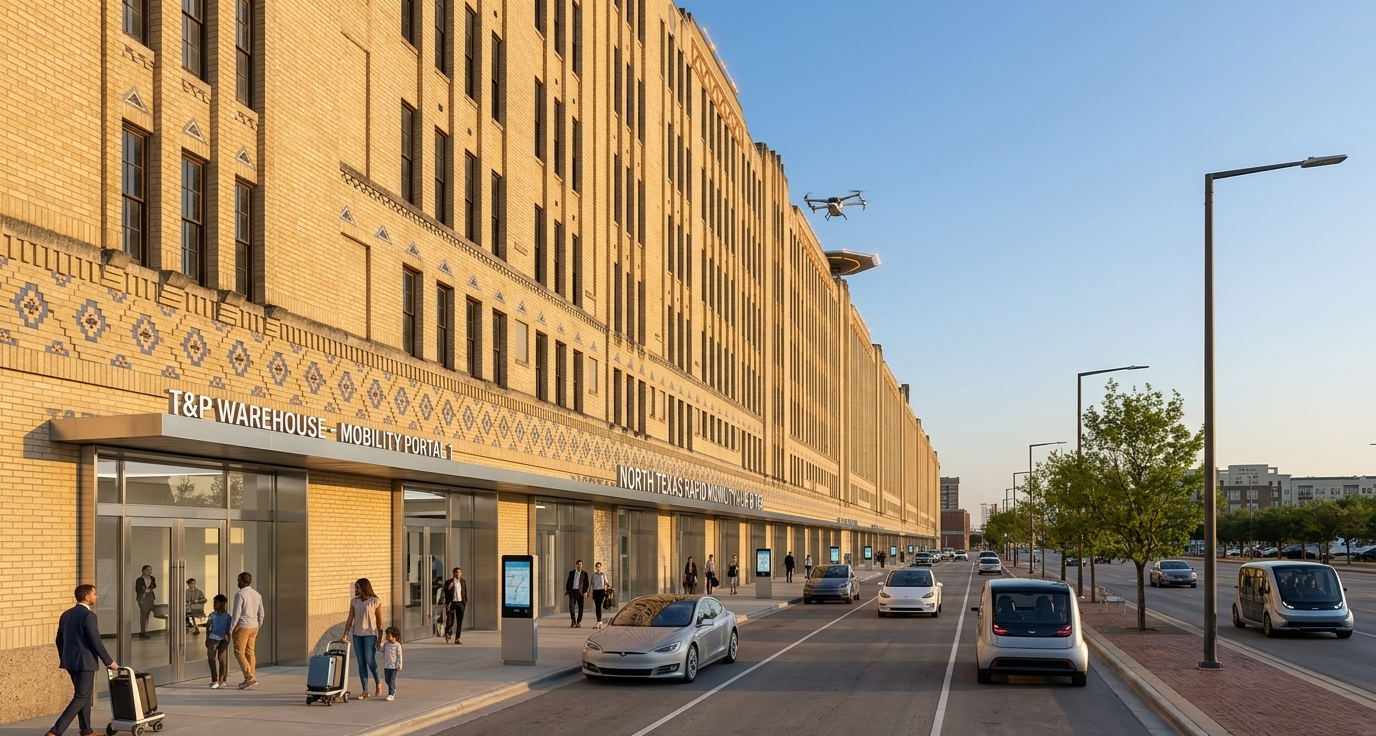
Texas & Pacific Warehouse
221 W. Lancaster Avenue, Fort Worth, TX
- 8-story historic warehouse: 600 ft × 100 ft = 480,000 gross SF
- 120,000 SF leasable Innovation Center (floors 2–7)
- Rooftop: eVTOL landing pads + charging infrastructure
- Ground level: AV terminal, passenger processing, retail
- Adjacent to Amtrak station, TEXRail, Trinity Metro bus hub
- Structural repair: $2.15M (already assessed)
- Federal Historic Tax Credit eligible: 20% of qualified expenses
- Class A downtown FW office rent: $30.68/SF (CommercialCafe, 2025)
Financial Projections
Capital Deployment by Phase
Phase 1
Planning & Prep
2026
$20M
Regulatory, design, team, eVTOL/AV MOUs
Phase 2
Infrastructure
2027
$50M
T&P renovation, rooftop eVTOL facilities, AV terminal
Phase 3
Technology
2028
$10M–$32M
Operator access infrastructure, charging/energy systems, AI traffic management, dispatch software, passenger processing systems, and optional seed fleet participation
Phase 4
Operations
2029
$22M
Working capital, fleet expansion, marketing launch
Year 5 Revenue by Stream (Moderate Scenario)
| Revenue Stream |
Conservative |
Moderate |
Optimistic |
Assumptions (Moderate) |
| Air Mobility Platform Revenue |
$21.9M |
$54.8M |
$131.4M |
Pad access fees, stand/use fees, passenger facility charges, terminal fees, charging/energy markup, dispatch/scheduling software fees, data/traffic management fees, maintenance bay/hangar access fees, and revenue share per passenger/trip |
| Ground Mobility Platform Revenue |
$16.4M |
$54.8M |
$137.3M |
Qualified operator network throughput with Trinity platform/service fee monetization |
| Innovation Center (Real Estate) |
$2.4M |
$3.8M |
$5.1M |
120K SF × 90% occupancy × $35/SF/yr |
| Technology Licensing / IP |
$4.0M |
$10.0M |
$16.0M |
Partner licensing + consulting |
| Ancillary (Retail, Cargo, Parking) |
$6.0M |
$10.0M |
$16.0M |
Retail/dining + cargo operations |
| TOTAL REVENUE |
$50.7M |
$133.4M |
$305.8M |
|
| Total OpEx |
($103.5M) |
($88.5M) |
($73.5M) |
Personnel, tech, facilities, debt service |
| EBITDA |
($52.8M) |
$44.9M (34%) |
$232.3M (76%) |
|
5-Year Cash Flow (Moderate Scenario)
| Year |
Phase |
Capital Deployed |
Revenue |
Operating CF |
Cumulative CF |
| 2026 | Phase 1 | ($20M) | $0 | ($5M) | ($25M) |
| 2027 | Phase 2 | ($50M) | $5M | ($10M) | ($80M) |
| 2028 | Phase 3 | ($10M–$32M) | $25M | ($5M) | ($70M to $92M) |
| 2029 | Phase 4 | ($22M) | $65M | $20M | ($29M) |
| 2030 | Phase 5 | ($5M) | $133M | $45M | +$44M |
24.8%
Calculated IRR — Before Terminal
Investment schedule: ($20M) / ($50M) / ($10M–$32M) / ($22M)
IRR method: 10-year capital-light moderate project cash flow before terminal value; terminal value shown separately as exit/refinance upside
With terminal value: 36.8% IRR · $293.2M NPV @ 10% · $480M moderate terminal value (8.0x Year 10 EBITDA)
Break-even: Year 5 (2030) — positive annual cash flow target
Capital Structure
Capital-Light Case — $107M–$113M
Preferred base case. Operators fund vehicles; Trinity Air Link funds infrastructure, dispatch, charging, passenger systems, safety, and access operations.
Hybrid Case — $115M–$121M
Limited demonstration/seed vehicles are funded by Trinity Air Link while operators carry most fleet capex.
Owned-Fleet Case — $129M
Upside/control case. Trinity Air Link buys or finances initial fleet, capturing more direct revenue but taking more asset, maintenance, insurance, and debt exposure.
Phase 1 Raise — $20M
Planning, regulatory, design, team buildout, operator MOUs, and FAA eIPP pathway work.
Competitive Moat
Physical Infrastructure Scarcity
The T&P Warehouse is the only building in downtown Fort Worth with the footprint, structural capacity, and multimodal adjacency (Amtrak, TEXRail, bus) to serve as a true intermodal hub. Competitors cannot replicate the location.
Regulatory First-Mover
FAA eIPP participation + established relationships with TxDOT Aviation, Fort Worth municipal partners, and FAA regional office create a regulatory moat that delays any competitor by 18–36 months.
Operator-Agnostic Platform
The Link charges landing/docking/terminal fees like an airport or port, not a single-operator service. Joby, Archer, Waymo, and others all pay to access the infrastructure — diversifying away from any one technology provider.
Multi-Revenue Lock-in
Innovation Center tenants on multi-year leases + certified eVTOL operator MOUs + qualified AV operator contracts create a layered revenue stack where no single stream dominates. Each layer protects the others.
Historic Tax Credit Arbitrage
Federal 20% Historic Tax Credits on qualified renovation expenses reduce effective cost by $3–4M and create a preferential capital structure unavailable to new-build competitors.
Network Effect Potential
Each eVTOL route added increases value of all existing routes (more O&D pairs). Each AV vehicle added reduces per-ride unit cost. The hub model compounds in value as scale increases — a classic network effect.
Key Risks & Mitigations
FAA Approval Delays — eVTOL certification slower than projectedMEDIUMMitigation: AV operations and terminal/charging revenue can phase first; eIPP supports readiness while certification progresses
Construction Cost Overruns — Historic renovation complexityMEDIUMMitigation: contingency reserve; fixed-price contracts; structural pre-assessment
Market Adoption Pace — Consumer uptake of eVTOL slower than modeledMEDIUMMitigation: capital-light structure avoids direct fleet-cost trap; real estate and platform fees provide floor
Owned-Fleet Exposure — Direct vehicle ownership before route economics are provenMEDIUMMitigation: owned-fleet case remains optional; downside stress case is explicitly modeled
Competitor Entry — Large tech players entering DFW marketLOWMitigation: physical infrastructure moat; exclusive location; regulatory relationships
Exit Pathways
Strategic Acquisition
4–7×
Revenue multiple · eVTOL manufacturer or mobility platform acquires infrastructure layer
Infrastructure REIT / Fund
6–10×
EBITDA multiple · transportation infrastructure asset recapitalization
IPO / SPAC
Market
Potential public listing only after operational proof and multi-market replication
Technology Partner Ecosystem
Operator-agnostic infrastructure enables partnerships with leading certified or near-certified operators:
Archer Aviation
Joby Aviation
Waymo
Beta Technologies
Wisk Aero
Vertiport / charging operators
Phase 1 Capital Raise — $20M Target
Seeking lead investor for Phase 1 execution: regulatory pathway, operator agreements, design, site control, technical due diligence, and public-sector coordination.
Schedule an Investor Briefing
partnerships@trinityairlink.com
Due diligence package, financial model, and technical specifications available under NDA