TRINITY AIR LINKInvestor Kill Sheet · Confidential · March 2026
The deal is not “buy flying cars.”
It is own the node.
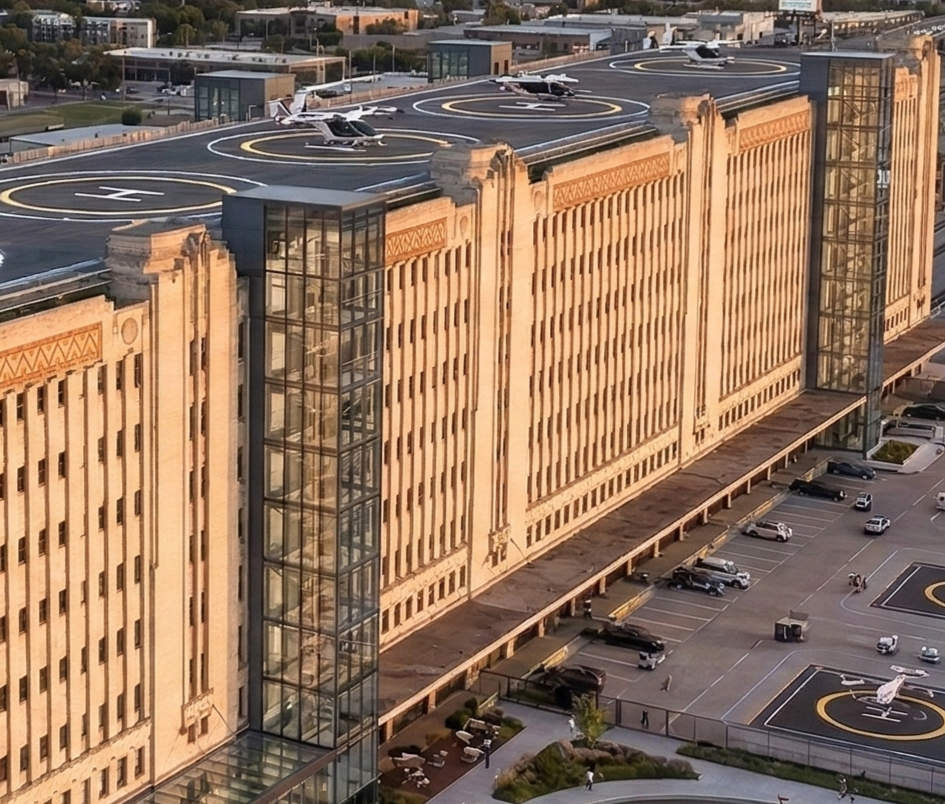
Trinity Air Link converts Fort Worth's historic T&P Warehouse into the infrastructure layer every certified eVTOL and qualified autonomous vehicle operator needs to use: vertiport access, AV bays, charging, dispatch, passenger processing, data, and service standards.
24.8%Calculated IRR
Before Terminal
Before Terminal
$89.7MNPV @ 10%
Before Terminal
Before Terminal
36.8%IRR With
Terminal
Terminal
$293.2MNPV With
Terminal
Terminal
$107M–$113MCapital-Light
Investment Case
Investment Case
Investor headline: The preferred capital-light moderate case produces a calculated 24.8% 10-year project IRR before terminal value and $89.7M NPV at a 10% discount rate before terminal value. Terminal value is shown separately as exit/refinance upside, not operating cash flow magic.
Why this is not a moonshot
- Operator access model: certified operators carry aircraft, pilots, maintenance, insurance, and fleet financing.
- Infrastructure economics: Trinity Air Link monetizes access, charging, dispatch, passenger processing, data, and operator agreements.
- Owned fleet stays optional: direct vehicle ownership is a tactical upside case only where route economics are proven.
- Multiple revenue streams: air mobility, ground mobility, real estate, technology/data, and ancillary services.
What kills the deal if ignored
- Do not lead with a forced $32M vehicle purchase assumption.
- Do not blend terminal value into base operating returns.
- Do not let the conservative case look like the normal base case if it assumes low demand plus owned-fleet exposure.
- Do not pitch as an airline, taxi company, or aircraft leasing company. Pitch as infrastructure.
Return stack
| Case | IRR Before Terminal | NPV Before Terminal | IRR With Terminal |
|---|---|---|---|
| Conservative | 5.0% | ($23.9M) | 18.3% |
| Moderate / Base | 24.8% | $89.7M | 36.8% |
| Optimistic | 55.7% | $440.3M | 62.8% |
| Owned-fleet stress | (17.2%) | ($139.6M) | 2.3% |
Why now
- Texas DOT + Archer selected for federal eVTOL Integration Pilot Program.
- Dallas is named in Texas route planning; Fort Worth needs the western DFW infrastructure anchor.
- Waymo is already commercial in Austin and expanding toward Dallas.
- T&P Warehouse is rare: historic, large, rail-adjacent, downtown, and structurally suited for a mobility hub.
Use of capital
- Phase 1: $20M — regulatory, design, site control, partner MOUs, team.
- Phase 2: $50M — renovation, rooftop vertiport, AV terminal, charging, systems.
- Phase 3: $10M–$32M — operator access infrastructure, dispatch, charging, optional seed fleet.
- Phase 4: $22M — launch, operator scale-up, working capital, route expansion.
Investor objections answered
- Certification risk: hub can phase AV/real estate/platform revenue while eVTOL certification progresses.
- Fleet capex risk: shifted to operators under the preferred model.
- Demand risk: conservative platform case is modeled; owned-fleet low-demand case is explicitly stress-tested.
- Exit risk: infra recap, strategic acquisition, REIT-like asset sale, or franchise/licensing path.
The ask
Lead or join the Phase 1 financing to lock the site, regulatory pathway, operator access agreements, design package, and public-sector alignment before the Texas eVTOL network hardens without Fort Worth.
$20M
Phase 1 Raise
Phase 1 Raise